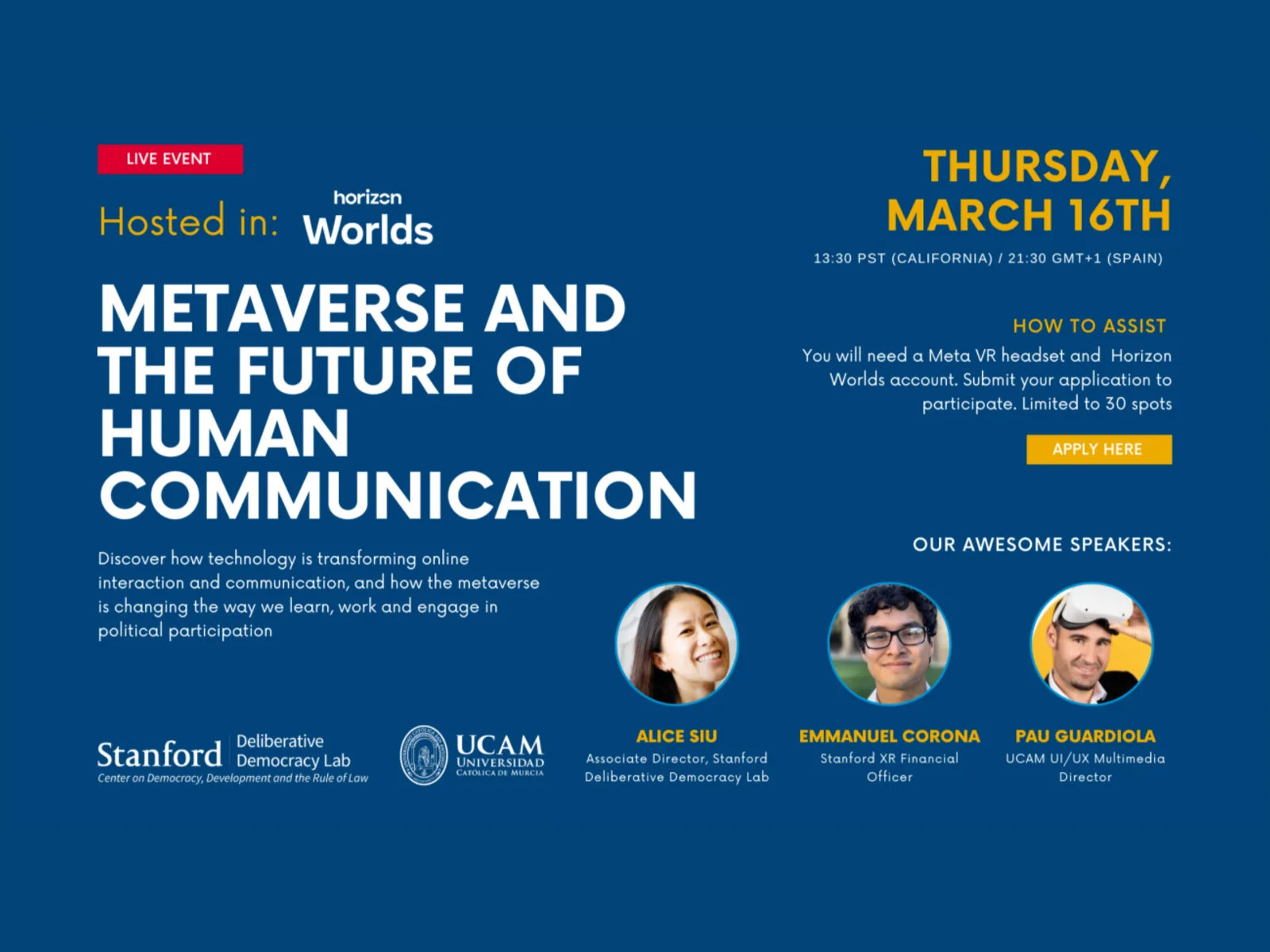
Two years as a research assistant with the Stanford Deliberative Democracy Lab, building the Horizon Worlds venues where policy deliberation went virtual, and speaking to an international audience from inside one of them.
Online political talk drifts toward broadcast. The loudest voices carry, nobody is obligated to listen, and opinions harden instead of moving. Prof. James Fishkin's Deliberative Polling is the lab's decades-old counter to this: give people balanced briefing materials, put them in moderated small groups, let them question experts, and measure what considered opinion looks like on the other side.
The lab's open question was what happens when that structure moves into embodied VR. Presence and spatial turn-taking could make listening real again. Headset access and moderation at embodied scale could break everything the method depends on.
I built custom virtual worlds in Meta Horizon Worlds shaped for policy discussion, venues where small groups could gather, see each other, and take turns. I helped facilitate the deliberation sessions the lab ran inside them, and implemented the deliberative polling structure so a session in VR still carried the method's spine of briefing, discussion, and measurement.
The part that still gets me: some sessions had participants debating metaverse moderation policy from inside the metaverse. The subject of the deliberation and the venue hosting it were the same thing. Nobody had to imagine the stakes, they were standing in them.
| Step | Detail |
|---|---|
| 1. Balanced briefing | Participants receive carefully balanced briefing materials before the session, so discussion starts from shared information instead of headlines. |
| 2. Small-group deliberation | Groups meet inside the custom Horizon Worlds venue with a facilitator keeping turns fair, the step where presence matters most. |
| 3. Plenary with experts | Small groups surface their hardest questions to experts in a plenary session, completing the informed half of informed opinion. |
| 4. Pre and post surveys | The same instrument before and after. The delta between raw opinion and considered opinion is the finding. |
The flagship moment was March 16, 2023: Metaverse and the Future of Human Communication, a live event hosted fully inside Horizon Worlds, run with UCAM in Spain. Thirty participant spots, an audience spanning California afternoon and Spanish night. I spoke as Stanford XR's Financial Officer alongside Alice Siu, the lab's Associate Director, and Pau Guardiola of UCAM, from inside a venue like the ones I had been building.
I was a research assistant with the Stanford Deliberative Democracy Lab from September 2022 to November 2024. I built the Horizon Worlds environments the sessions ran in, helped facilitate the VR deliberation sessions themselves, and implemented the deliberative polling flow that kept a VR session methodologically honest. At the March 2023 event I was also a speaker, representing Stanford XR.
The collaboration ran through Alice Siu, Associate Director of the lab, and cross-institution with Pau Guardiola at UCAM Universidad Católica de Murcia.
Deliberation turns out to be an interface problem. The method already knew how to fix online discourse, what it needed was a room, and VR is the first medium since the town hall that lets you design the room itself. Presence and spatial turn-taking are design levers screens do not have. Headset access and embodied moderation are failure modes screens do not have either. Building the venues taught me that designing the space is designing the conversation, which is the same lesson every project on this site keeps teaching me in different clothes.