Virtual Becomes Reality
Two decades of Stanford VR research, locked to a tethered lab headset. I led the port that brought it to standalone Quest, putting it in reach of millions instead of the 15,000 who could visit in person.
Twenty years of VR research, locked in one room
For nearly two decades, Stanford’s Virtual Human Interaction Lab was a pilgrimage: every Friday at 4pm, the first 24 people in line got a tour. The experience that captured all of it, Virtual Becomes Reality, needed a VR-capable PC and a tethered headset, gating two decades of behavioral science to people who could fly to Stanford or afford a PC-VR rig.
View data
| Audience | People | Dots |
|---|---|---|
| in-person VHIL visitors | 15,000+ | 1 |
| standalone Quest headsets | 20M+ | 1333 |
The opportunity was obvious. The port was not. Moving a high-fidelity desktop experience (volumetric video, complex 3D environments, 360° cinematography) onto a mobile processor is a port many teams attempt and abandon.
Re-architect for mobile, don’t just downscale
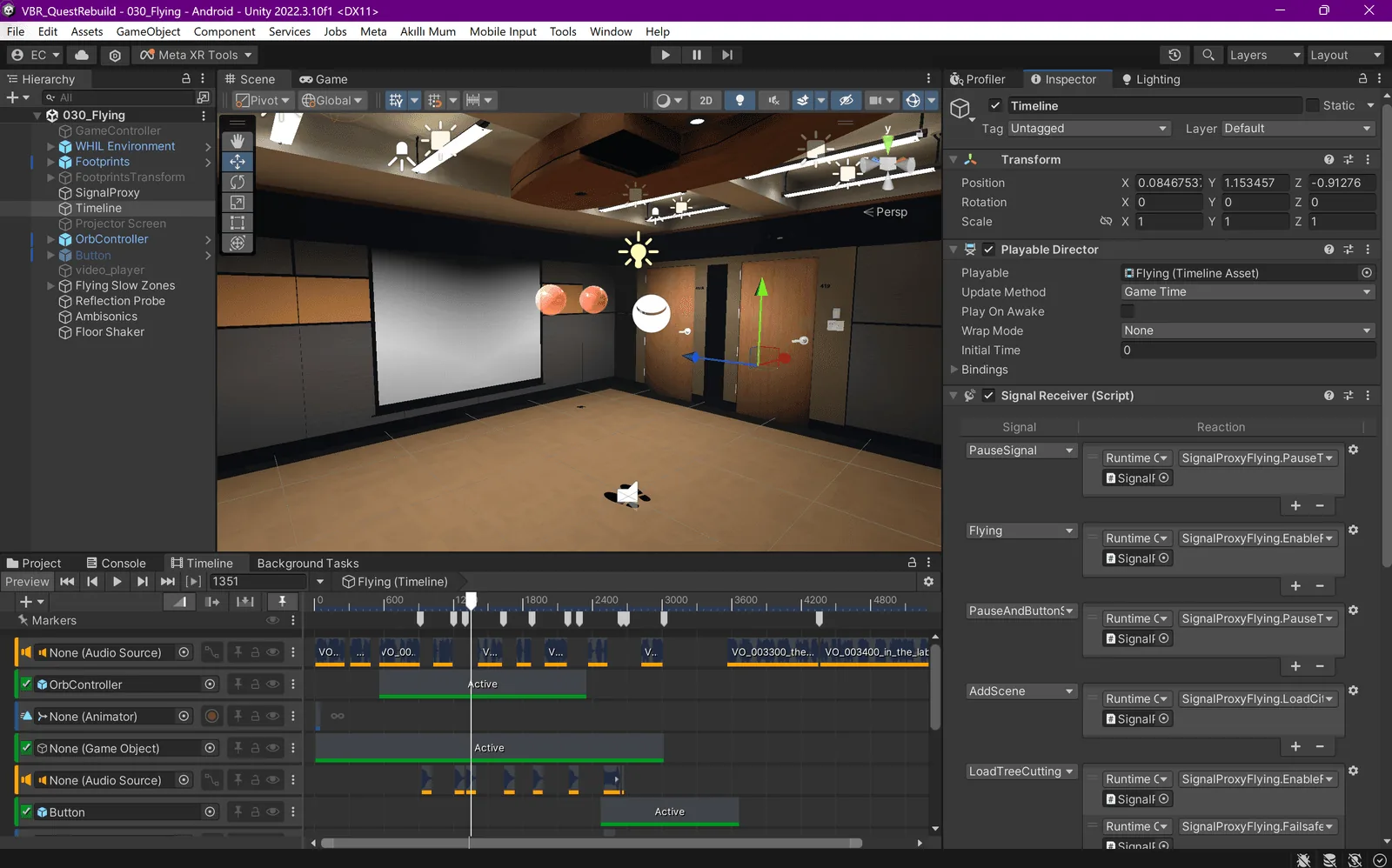
A naive port chokes a mobile GPU. The unlock was treating this as a performance re-architecture, not a resolution cut: migrate the whole render pipeline to one built for mobile, rebuild scene management around the memory Quest actually has, and make every interaction work controller-free, so the science is accessible the moment someone puts the headset on.
What it took to hit 72Hz on a mobile chip
Users can start from any scene. The intended journey runs 1 to 9
- 1IntroductionVHIL's history and the evolution of VR
- 3HMDs and the Bobo Dollearly headsets, then a classic psychology recreation
- 6Palau360° immersion in Micronesian coral reefs
- 9Mirror and Third Armembodiment: see yourself as someone else
Step details
| Step | Detail |
|---|---|
| 2. The Plank | Your body reacts to a drop it knows is virtual: the classic presence demonstration. |
| 4. Superhero Flight | Raise your hands to take off and tilt them to steer, re-optimized to run on a mobile GPU. |
| 5. Tree Cutting | Cut down a virtual tree, hearing every crack: tied to VHIL's research on environmental behavior. |
| 7. Football | Step into the pocket and read the defense from the quarterback's view, VHIL's research on VR for athletic training. |
| 8. Grover | Share the space with a virtual character the way a child does, VHIL's research on how kids relate to and remember virtual others. |
Accessibility was part of the port, not an afterthought: first-time-in-VR onboarding questions, one-handed (“Left only / Right only”) modes, full hand tracking, and seated support.
From 15,000 visitors to anyone with a Quest
I led the Quest port end to end: the core systems architecture (scene-management rewrite, Unity Timeline narrative system), the interaction layer (Meta hand tracking across every scene), and the performance work that made it possible (the URP migration, draw-call reduction, and texture optimization that hold 72Hz+ on a mobile chip). I also onboarded and mentored the developers who joined for the second half of the port, and set the architecture that let scenes be built in parallel.
Built at the Stanford Virtual Human Interaction Lab with Victor Chen and Ana Nguyen (porting) and Na Young Son (spatialized audio), advised by Prof. Jeremy Bailenson (VHIL founding director). The original desktop experience was developed by a larger VHIL team.
The temptation in a port is to shrink everything until it runs. The lesson was the opposite: what mattered wasn’t subtraction, it was re-architecture: a render pipeline built for mobile, a scene system built for the memory you actually have, interactions built for the hands people actually bring. And the part I care about most isn’t the framerate: two decades of research that used to require a plane ticket now installs on a headset people already own. Performance was the means. Access was the point.