MRI Simulator
A mixed-reality rehearsal that prepares anxious patients for an MRI, and made them 100% more likely to call the experience engaging than standard prep videos.
Too many scans end before they begin
MRI exams are routinely terminated when patients panic in the bore, and the population it hurts most is the one least able to cope with it.
Standard prep is a passive video. The open question: could an interactive VR rehearsal on a standalone headset prepare patients better?
A rehearsal, not a video
We ran a randomized crossover pilot (n=14): every participant experienced both the VR simulator and the standard hospital training video in counterbalanced order, rating each. The design question was which medium teaches the two things that actually end scans: holding still, and the noise.
Designing for stillness under stress
- 3Passthrough transitionsee the real bed as you lie down, physical safety first
- 4Into the boreauthentic recorded MRI noise in spatial audio
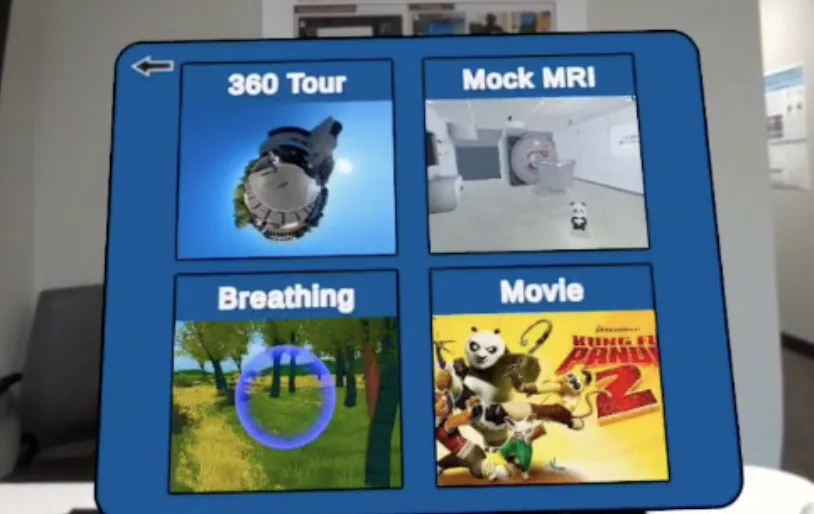
- 1Main menusqueezing returns here, just like a real scan stop
Step details
| Step | Detail |
|---|---|
| 1. 360° hospital tour | Familiarizes patients with the room and pre-scan steps before they ever arrive. |
| 2. Panda narrator | A kid-friendly avatar (with an adult-narrated alternate) explains the procedure. |
| 3. Passthrough transition | Patients see the real bed through mixed-reality passthrough as they lie down: physical safety before entering the virtual bore. |
| 4. Into the bore | Noise captured from real machines plays in spatial audio to desensitize patients to the scanner's sound. |
| 5. Hold still | A movie pauses when the head drifts to the yellow zone and disappears in the red zone, turning the hardest instruction into a game. |
| Escape | Squeezing at any point returns to the main menu, exactly like stopping a real scan. The escape is not failure, it is the mechanic that teaches recovery. |
| Escape: Breathing exercise | A separate experience launched from the menu that teaches breathing as emotional regulation, so patients return to the scan able to hold still. |
Engagement and preparedness, with significance
View data
| Metric | Prep video | VR simulator | Significance |
|---|---|---|---|
| Engagement | 2.64 | 4.79 | p = .002 |
| Preparedness | 3.86 | 4.64 | p = .034 |
View data
| Question | Share |
|---|---|
| chose VR as more immersive | 100% |
| preferred VR for their actual prep | 85.7% |
Deployed on Quest devices at Stanford Lucile Packard Children's Hospital and the Chariot Lab, with interest in future clinical studies.
I co-designed and developed the interaction and narrative flows (the breathing exercise, the 360° tour, the squeeze-ball input) and implemented the core mixed-reality functionality. I contributed to the study design for evaluating anxiety reduction, and helped translate clinical requirements into interaction constraints so the simulator stayed faithful to real MRI workflows while still feeling approachable.
Co-developed with Yue Yang. Mentored by Prof. Bruce L. Daniel and Christoph Leuze (IMMERS), with clinical guidance from the Chariot Lab.
Average anxiety scores were lower with VR (1.14 vs 1.50) but not statistically significant (p = .317): almost certainly a floor effect from testing healthy volunteers with low baseline anxiety. The honest read: engagement and preparedness were the real, defensible wins, and the next study needs the actual anxious population the tool is built for. Designing the hold-still mechanic taught me that the hardest clinical instruction becomes learnable the moment you make the feedback immediate and the stakes playful.