Cypherspace
A culturally-grounded MR/VR experience that teaches the five pillars of hip-hop through embodied play. I led XR development for two scenes, a DJ booth where you physically scratch and fade records, and a cypher floor that teaches you to dance, BeatSaber-style. An HCI research project on how embodied interaction can make learning joyful.
Teaching hip-hop by doing it, not watching it
Cypherspace sets out to physically and socially engage intergenerational audiences in the history of hip-hop and its broader socio-political context, teaching its five foundational pillars: MCing, DJing, Graffiti, Breaking, and Knowledge. Rather than narrate that history, the MR/VR experience guides learners through it with embodied activities, then culminates in a reflection-based moment with an interactive agent that draws on both what they've learned and their own lived experience.
The research question underneath it: how might embodied interaction support joyful learning outcomes? My work centered on answering that for two of the pillars, putting the user's hands on the turntables and their whole body into the cypher.
Two scenes that turn the user into a participant
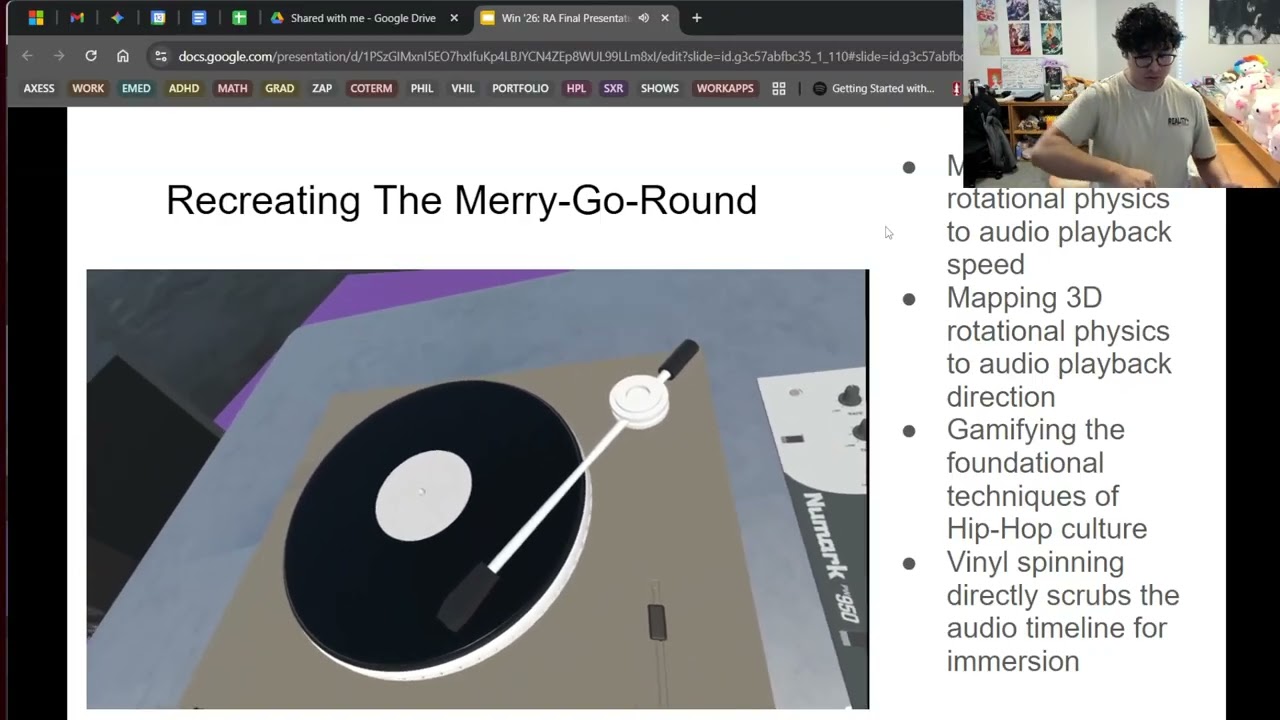
The DJ booth: turntablism you do with your hands. I built the assets and the interactive features that make the DJ pillar feel real: vinyl scratching, fade transitions between tracks, and the rest of the manipulations that let a learner actually perform as a DJ rather than press a "play DJ" button. The goal was for the act of mixing to carry the lesson. You understand DJing because your hands just did it.
The cypher-dance floor: movement teaching, BeatSaber-style. Teaching someone to move like a cypher dancer is hard: you can't read it off a card. So I implemented a timeline-based interactive flow where cues travel toward the user (think Just Dance guidance reimagined as BeatSaber blocks), guiding their body, beat by beat, through the moves a real dancer executes. It turns choreography into something you follow with your whole body, in rhythm, instead of imitating a video.
Both scenes are built on the same conviction the project is testing: that embodiment is the teacher. The experience as a whole then closes with a reflection-based activity and an interactive agent (the broader team's design) that ties the learner's new knowledge back to their own life.
A research project I helped build and presented
I was Lead XR Developer for the DJ scene and the Cypher Dance scene. On the DJ side, I created the assets and the interactive features essential to the experience (fade transitioning, vinyl scratching, and more) so the DJ pillar could be performed, not just demonstrated. On the dance side, I implemented the timeline-based, BeatSaber-style interactive flow that teaches users to move like a cypher dancer, with movement cues that come to the user to guide each step. Across both, my focus was developing for embodied interaction, and I presented the work as part of the project.
Cypherspace is a collaboration led by Cyan with the Stanford HCI group.
The hardest and most interesting part was making movement teachable in VR. A scratch or a dance step isn't information you can hand someone on a card. It lives in timing and the body. Borrowing the BeatSaber idiom let cues meet the user in rhythm, so learning a move felt like playing rather than studying. That's the whole thesis of the project in miniature: when the interaction is embodied, the culture isn't something you read about. It's something you do, and the joy of doing it is what makes it stick.