CogLoad
A biofeedback instrument that asks “is it my body, or my mind?”, synchronizing what a VR game demands with what your body spends, so cognitive and physical load can finally be told apart.
Is it my body, or my mind?
Halfway through a hard Beat Saber run, or a boxing round, you fall apart, and you genuinely cannot tell why. Is your body tired, or is your mind fried while your body is fine? Two tanks drain when you play: physical load (your body working) and cognitive load (your brain tracking and reacting under pressure). Both exhaust you.
Your watch shows heart rate. The game shows your score. Nobody tells you, in real time, how much of your collapse was body versus mind. I call that gap the embodied split, and the fix depends on the answer. If it is your body, you rest. If it is your mind, that is a different kind of break entirely.
Measure both channels, or measure nothing
The split is only knowable if you capture both sides on the same clock: what the game demanded and what the body spent. A controlled VR environment is the unlock: Beat Saber labels every second with exactly how hard it was pushing you. That is ground truth no wearable has, because no wearable knows what you were being asked to do.
So rather than guess at the split, I built the instrument that records both channels, synchronized, and keeps the physiology honest.
Building the ground-truth engine
A post-hoc Python analysis turns that raw capture into the Golden Graph: game difficulty, heart rate, and accuracy on one timeline.
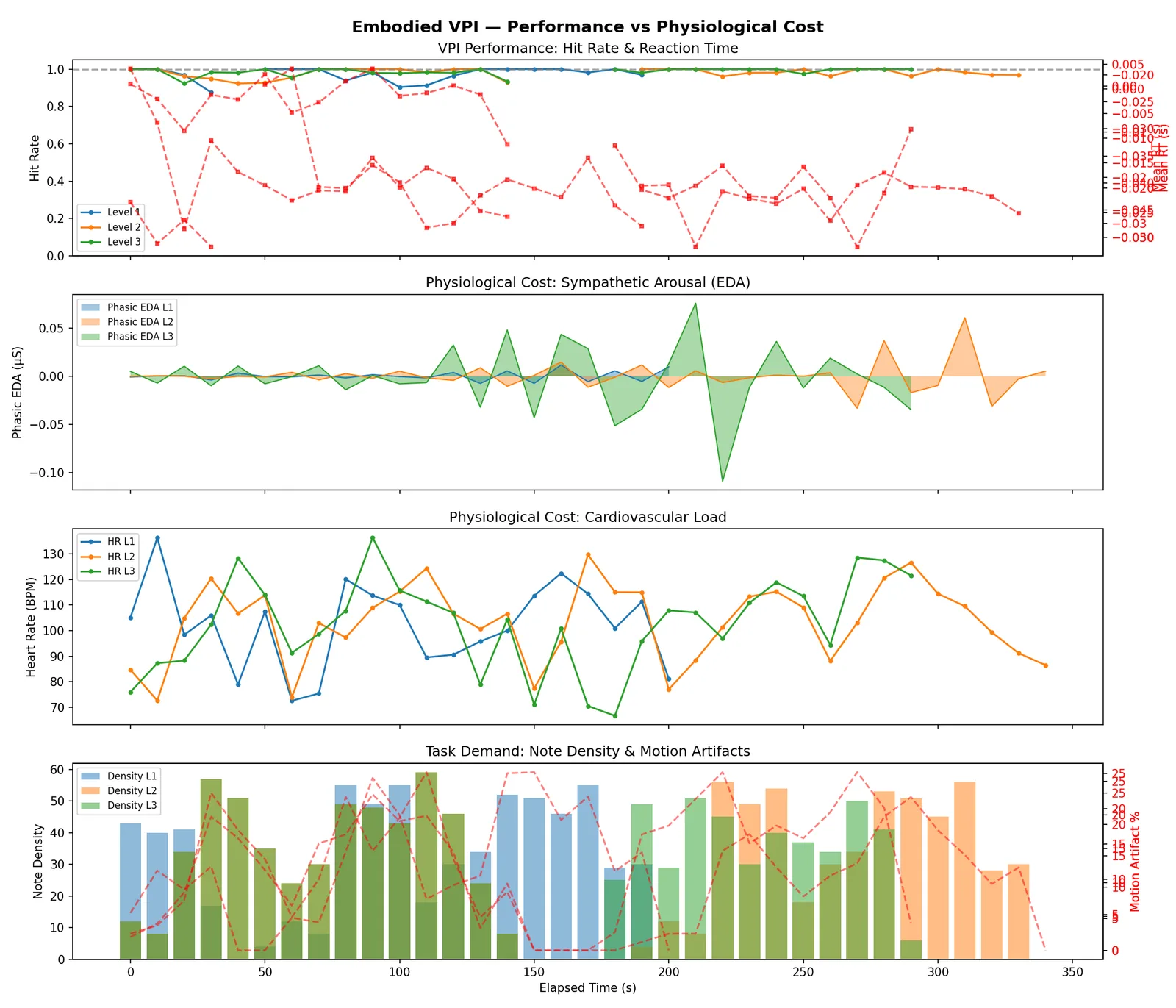
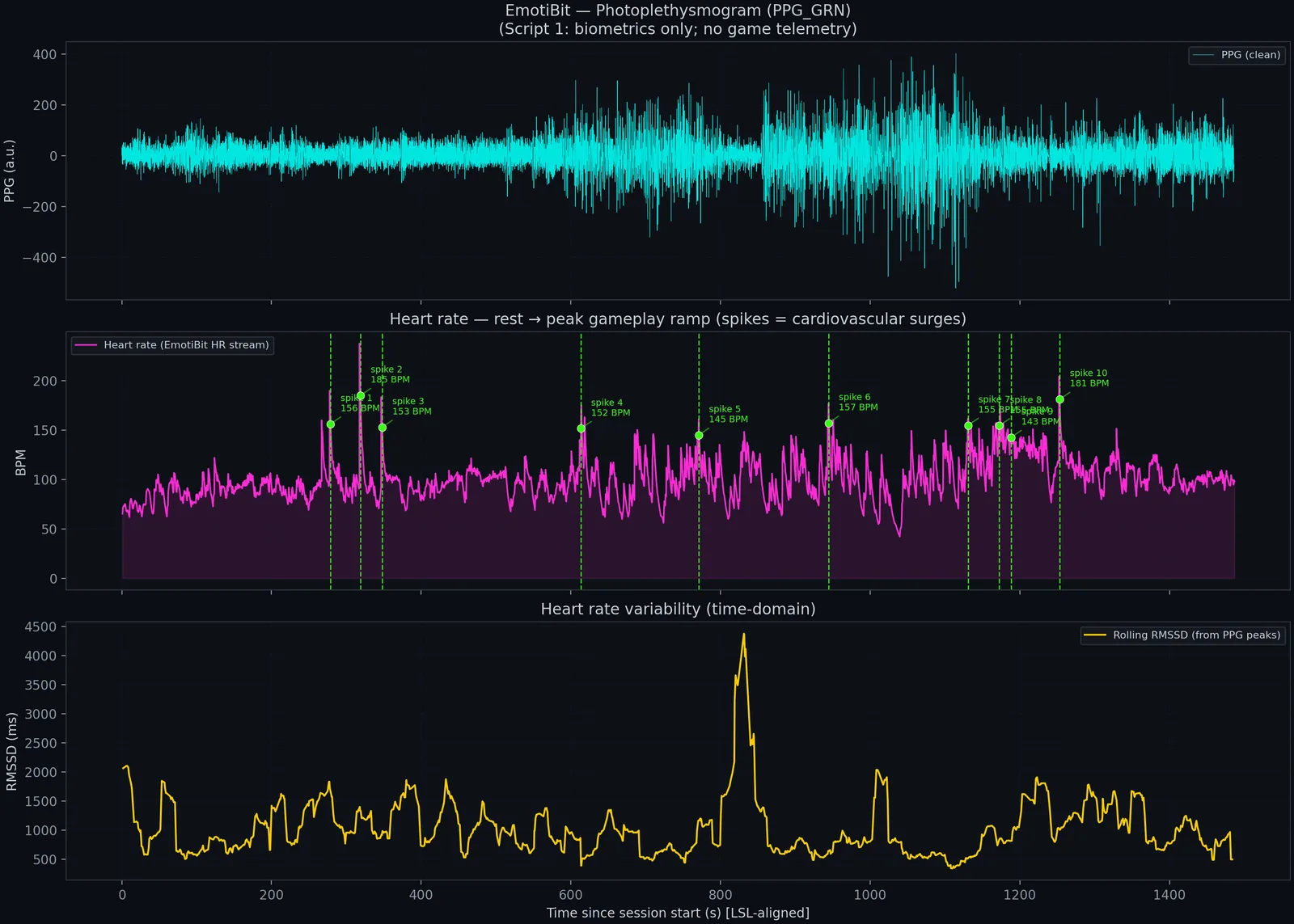
The body and the game agree
Stated honestly: this is an n=1, ~8-minute pilot (founder-as-user). The instrument and these correlations are real. The literal cognitive-vs-physical split readout, consumer dashboard, and Fitbit / Google Health bridge are the near-term build, not finished output. I presented exactly that line (validated capability, scoped roadmap) to an industry panel including the President of Riot Games.
CogLoad is a solo project: I conceived, built, and validated it end to end: the Beat Saber telemetry plugin, the EmotiBit + LSL synchronization, the motion-artifact gating, and the Python analysis that produced the Golden Graph. I ran the pilot as the first user and presented the work to a commercialization panel. Advised by Dr. Khizer Khaderi (Stanford Symbiotic Products).
The hardest call wasn’t technical. It was refusing to overclaim. In front of a sharp commercialization panel, the tempting story was “I separated mind from body.” The honest one was “I built the instrument that can, validated the channel on a pilot, and here is exactly what’s proven versus designed.” Protecting the gap between a validated capability and a finished product is what makes a result trustworthy. I also held two ethics lines that matter for biometric work: the data stays the player’s, and this is a sensory budget (energy spent on purpose), not a deficit to diagnose. The deeper insight is methodological: a game is a rare place where you get ground truth for free, because the game already knows how hard it is pushing you.